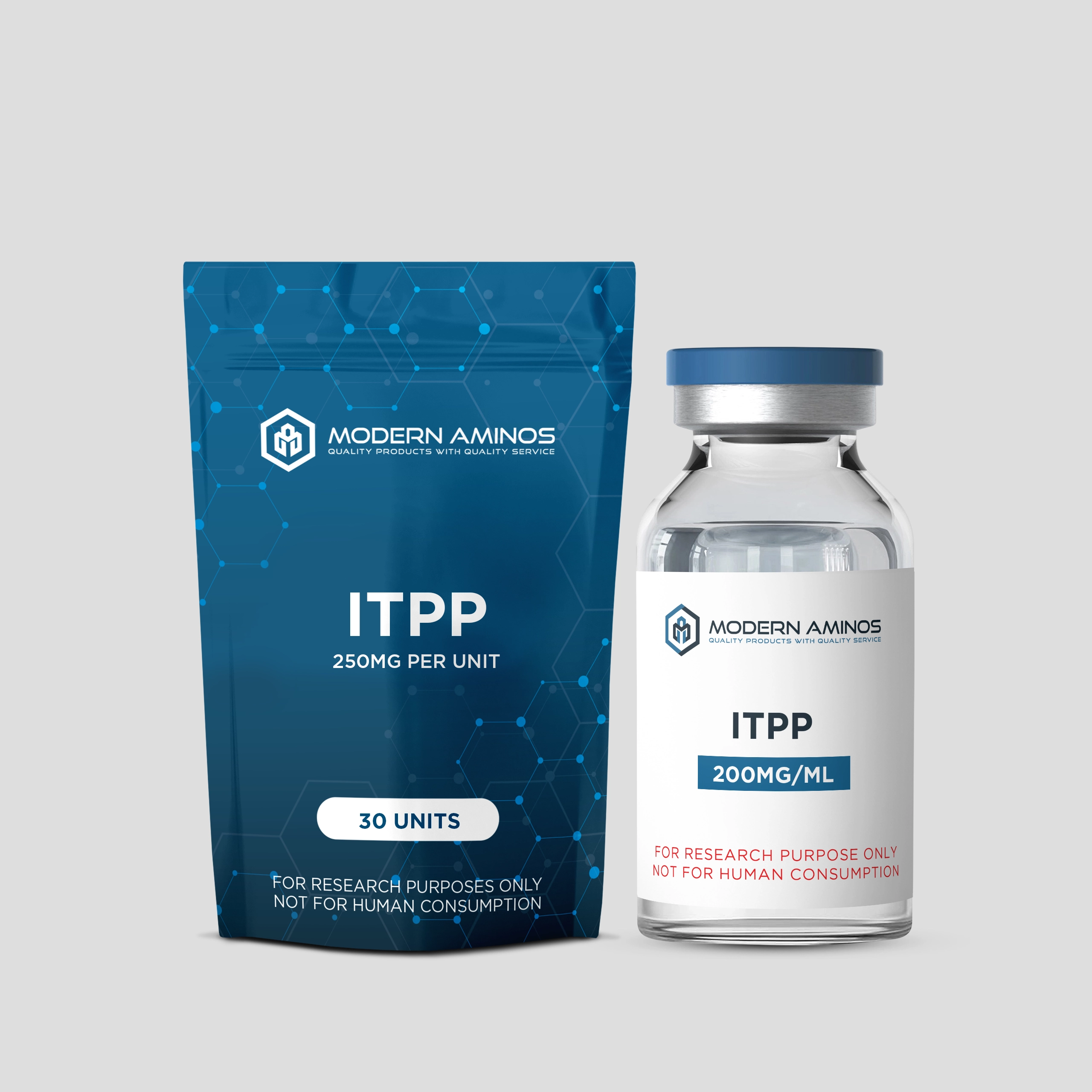
ITPP (myo-inositol trispyrophosphate) is a synthetic membrane-permeable allosteric effector of hemoglobin engineered to increase tissue oxygenation under hypoxic conditions. By binding allosterically to the central cavity of hemoglobin tetramers, ITPP stabilizes deoxyhemoglobin, right-shifting the oxygen-hemoglobin dissociation curve to raise P50. This facilitates targeted oxygen release into hypoxic microenvironments without stimulating erythropoiesis or altering hematocrit.
Price range: $134.00 through $189.00
| Quantity | Discounted Price |
|---|---|
| 4 - 6 | $128.64 |
| 7 - 9 | $125.96 |
| 10 + | $123.28 |
ITPP (known chemically as myo-inositol trispyrophosphate, hexasodium myo-inositol 1,6:2,3:4,5-tri-O-diphosphate, or OPP-111) is a lipophilic, membrane-permeable synthetic organic phosphate derivative. Developed as a targeted allosteric modulator of hemoglobin, ITPP penetrates red blood cell membranes to bind the central cavity of hemoglobin molecules, decreasing oxygen binding affinity in a controlled, reversible manner.
Unlike conventional metabolic modulators that act on nuclear receptors or kinase cascades, ITPP alters the physical thermodynamics of oxygen transport. By stabilizing the low-affinity T-state (deoxyhemoglobin), ITPP right-shifts the oxygen-hemoglobin dissociation curve, elevating the P50 value (the partial pressure of oxygen at which hemoglobin is 50% saturated). This significantly increases oxygen (O2) offloading into oxygen-deprived or ischemic tissues without reducing arterial oxygen loading in the lungs (SaO2).
Batch-verified for high analytical purity at Modern Aminos, ITPP is offered as a standardized reference material for cell culture and biochemical research. Researchers evaluating tissue hypoxia attenuation, tumor re-oxygenation kinetics, and oxygen-dependent bioenergetics utilize ITPP alongside complementary metabolic reference standards available on the site, such as AICAR, GW-501516 (Cardarine), SLU-PP-332, and BAM15.
| Compound Name | ITPP (myo-Inositol Trispyrophosphate Hexasodium) |
|---|---|
| Quantity / Formats Offered | High-Purity Dry Reference Powder / Solid Unit Material |
| Chemical Structure | Synthetic Inositol Phosphate Pyrophosphate Salt |
| Synonyms / Alt Names | myo-inositol trispyrophosphate, ITPP, OPP-111, OXY111, Hexasodium myo-inositol 1,6:2,3:4,5-tri-O-diphosphate |
| CAS Number | 1000242-70-1 (Hexasodium) | 362828-82-5 (Free Acid) |
| Chemical Formula | C6H6Na6O18P6 (Hexasodium Salt) |
| Molecular Weight | 671.88 g/mol (Hexasodium Salt) | 540.01 g/mol (Free Acid) |
| IUPAC Name | hexasodium; 2,3,4,5,6,7-hexaoxa-1,3,5-triphosphabicyclo[2.2.1]heptane 1,3,5-trioxide derivative |
| InChIKey | InChIKey=JKGJSQYRHQJFFP-UHFFFAOYSA-H |
| SMILES Code | [Na+].[Na+].[Na+].[Na+].[Na+].[Na+].O=P1(O[C@@H]2[C@H](OP(=O)(O1)O[C@@H]3[C@H]2OP(=O)(O3)O[C@@H]4[C@H]3OP(=O)(O4)O)O)O |
The biochemical pathways and cellular targets of ITPP (myo-inositol trispyrophosphate) in laboratory research include:
When evaluating research efficacy and published scientific literature for ITPP (myo-inositol trispyrophosphate):
To evaluate oxygen delivery mechanisms, metabolic pathways, and bioenergetic targets, researchers compare ITPP against alternative reference standards available at Modern Aminos:
In hypoxia and performance-modeling research, the mechanism of oxygen delivery dictates physiological response:
| Compound / Reference | Chemical Structure & Class | Core Mechanism of Action | Research Focus & Profile |
|---|---|---|---|
| ITPP (myo-Inositol Trispyrophosphate) | Synthetic Membrane-Permeable Inositol Phosphate Salt | Allosteric effector of hemoglobin; increases P50 to accelerate O2 offloading into hypoxic microenvironments | Focuses on tissue oxygenation, P50 curve right-shifting, ischemic re-oxygenation, and erythropoietin-independent respiration |
| AICAR | Nucleoside Analog Master AMPK Agonist | Mimics AMP to directly activate AMP-activated protein kinase (AMPK) independent of cellular ATP levels | Focuses on master metabolic switch activation, glucose uptake, GLUT4 translocation, and metabolic signaling pathways |
| GW-501516 (Cardarine) | PPARδ Selective Agonist | Recruits PGC-1α via PPARδ to upregulate skeletal muscle fatty acid beta-oxidation and PDK4 expression | Focuses on PPARδ nuclear receptor signaling, fatty acid transport (FAT/CD36), and glycogen sparing in myocytes |
| SLU-PP-332 | Pan-ERR Nuclear Receptor Agonist | Binds ERRα/β/γ receptors to recruit PGC-1α and upregulate mitochondrial OXPHOS gene transcription | Focuses on nuclear receptor exercise mimetics, oxidative muscle fiber switching, and de novo mitochondrial biogenesis |
Yes, Modern Aminos is a highly trusted vendor for high-purity research chemicals and reference compounds. Every batch of ITPP (myo-inositol trispyrophosphate) undergoes strict third-party analytical testing (including HPLC and Mass Spectrometry) to verify minimum 98%+ chemical purity, correct molecular weight (671.88 g/mol hexasodium salt), exact allosteric structure fidelity, and complete absence of heavy metals or synthesis impurities.
ITPP (myo-inositol trispyrophosphate) is a synthetic membrane-permeable inositol phosphate derivative. It is classified chemically as an allosteric effector of hemoglobin designed to modulate oxygen transport kinetics in red blood cells.
ITPP binds allosterically within the central cavity of hemoglobin tetramers, stabilizing the low-affinity T-state (deoxyhemoglobin). This right-shifts the oxygen-hemoglobin dissociation curve, elevating P50 and promoting O2 release in low pO2 tissue capillaries.
Unlike erythropoietin (EPO), which stimulates red blood cell production in bone marrow, ITPP acts directly on existing hemoglobin molecules. It increases the volume of oxygen released per erythrocyte passage without altering total blood volume or plasma viscosity.
In hypoxic tissue models, ITPP accelerates local O2 offloading, restoring aerobic metabolism and suppressing hypoxia-inducible factor 1-alpha (HIF-1α) expression. In tumor models, ITPP reduces core hypoxia, altering tumor vascularization and metabolic stress signaling.
AICAR (AMPK agonist) and SLU-PP-332 (pan-ERR agonist) act intracellularly on enzymatic and nuclear receptor transcription pathways. ITPP operates biophysically on circulating red blood cells to enhance extracellular O2 availability to tissues.
Modern Aminos utilizes High-Performance Liquid Chromatography (HPLC) to confirm active chemical purity exceeding 99% and Mass Spectrometry (MS) to verify exact molecular weight (671.88 g/mol hexasodium salt) and structural identity prior to batch release.
Dry reference material should be stored tightly sealed in a cool, dry environment (15°C to 25°C) or refrigerated for long-term preservation. Protect from direct heat, light exposure, and atmospheric moisture to maintain solid-state chemical stability.
Disclaimer: All compounds and research materials provided by Modern Aminos are strictly for laboratory and research professional use only. They are not approved for human or animal use nor consumption by the Food and Drug Administration (FDA). These products should not be used for any form of in vivo experimentation or for any other non-laboratory purpose. Any violation or indication of human or animal use will result in immediate removal from being able to purchase products in the future. By purchasing these products, you acknowledge that they will be used exclusively within a controlled and qualified research environment.
The products offered by Modern Aminos are intended strictly for laboratory research purposes only and are sold exclusively to qualified professionals, institutions, and entities. These products are not for human consumption, veterinary use, or any other application involving living organisms, including but not limited to diagnostic, therapeutic, or recreational purposes.
By purchasing this product, you confirm that:
Modern Aminos does not claim that this product is approved by the U.S. Food and Drug Administration (FDA) for any purpose. The statements regarding this product have not been evaluated by the FDA. This product is not intended to diagnose, treat, cure, or prevent any disease.
The buyer assumes full responsibility for ensuring the safe handling, storage, and use of this product. Modern Aminos is not liable for any damages, direct or indirect, resulting from improper handling, storage, or unauthorized use of this product. Furthermore, Modern Aminos reserves the right to refuse sales to any individual or entity suspected of misusing its products.
If you have questions about the safe and lawful use of this product, consult a qualified professional with expertise in laboratory research. By proceeding with this purchase, you agree to these terms and conditions.